A product leaderProduct LeaderDefines product vision, aligns teams and stakeholders, and turns business goals into products that create measurable user and business value. / product builderProduct BuilderTurns ideas into real, usable products by combining strategy, UX, technology, experimentation, and execution from concept to launch. using AI-native thinking to turn complex customer problems into clear, scalable digital products.
00:00:00
Warsaw
Thats So Random
Client
Self-founded, with Adam Romański
Scope
Product strategy, definition, UX, mechanics, roadmap
Year
2025 to now, in active development
Role
Co-Founder and Product Lead
Live site
thatssorandom.photo
In short
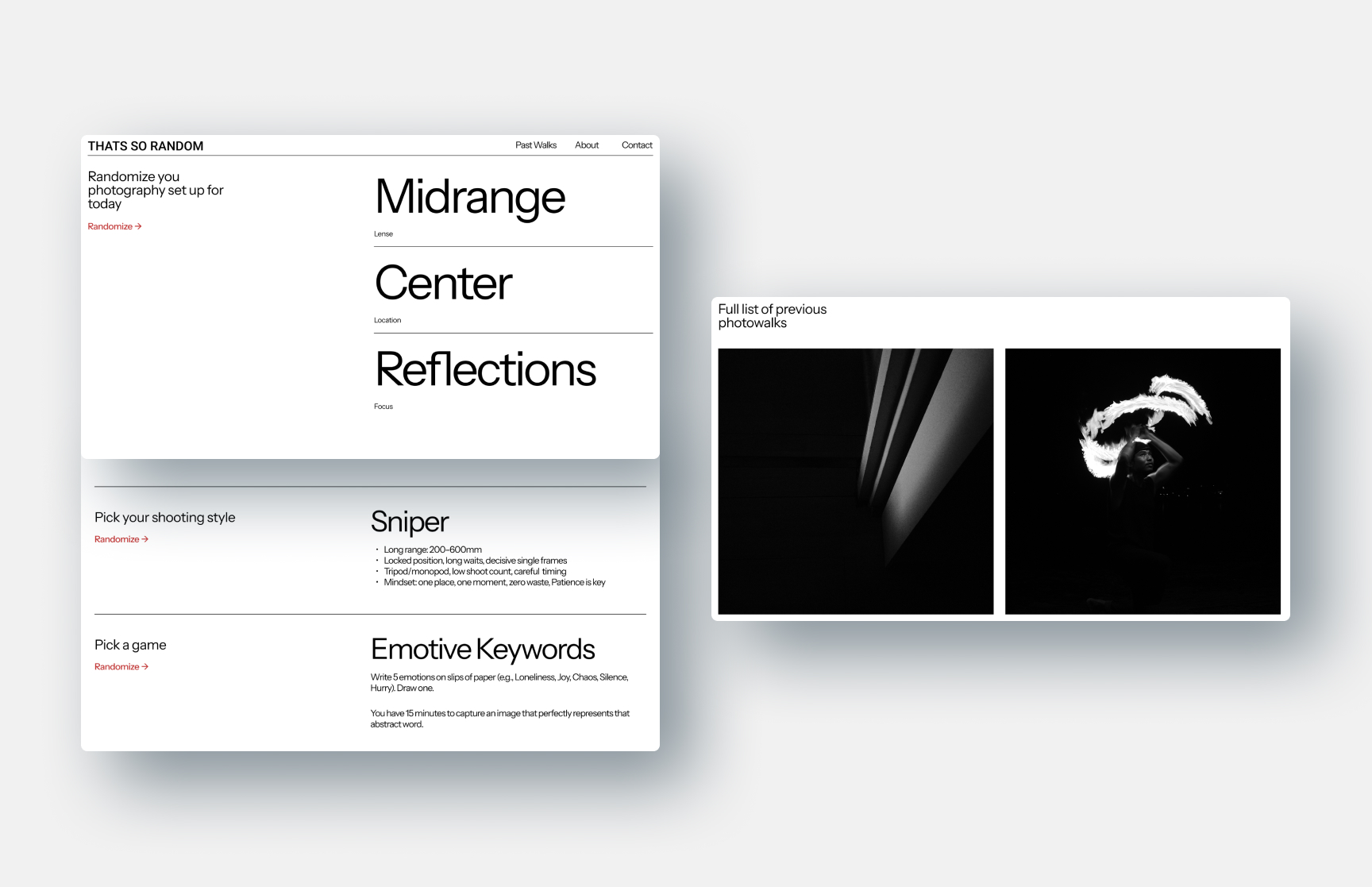
That's So Random is a self-founded digital platform built on one idea: sometimes creativity benefits from not knowing what comes next. It started as a conversation between Adam Romański, aka Hello Roman, and me. Both photography enthusiasts, we wondered whether randomness could nudge photographers out of their routines. Together, we're developing that idea into a platform combining creative tools, gamification, photography challenges, community and real-world experiences.
We both shape the concept, functionality and user flows. Our responsibilities overlap, with my focus leaning towards product and Adam's towards development and the backend. Explore where each of us spends more of our time.
I spend more of my time shaping the product: exploring what the platform could offer, connecting ideas into a coherent experience and working through what we should build next. The concept and user flows are shared work, developed through ongoing conversations and decisions with Adam.
- Shaping the product's direction, positioning and priorities
- Developing features, requirements and interaction ideas
- Working with Adam on user journeys and flows
- Exploring how randomisation, challenges and community fit together
- Refining the experience as we build and learn
Adam spends more of his time on development and the backend, working through how the platform functions and how its parts connect. Alongside that technical focus, he helps shape the concept, features and user flows. Our shared interest in photography informs both the product decisions and how we bring them to life.
- Developing the platform and its backend systems
- Shaping the technical architecture and implementation
- Working with me on the concept, features and user flows
- Exploring technical possibilities that inform the product
- Refining functionality and behaviour as the platform evolves
Try it yourself
The original idea was deliberately simple: let chance give photographers a starting point. The Randomizer spins three slots (Lens, Location and Focus) to create a photography brief. Keep a result you like by locking it, then randomize the rest. Randomizer Pro extends that control with photography modes, more variables, and your own themes and gear.
Custom themes and gear
Separate choices with commas. Leave empty to use the defaults. Up to 25 choices, 70 characters each.
Lock a slot to keep its result while the others spin.
Give it a spin.
Interactive case-study demo of the brief generator. Photo games and shooting styles are separate TSR tools. Saving challenges and account features are outside this demo.
From idea to product
The more the idea was explored, the clearer it became that the randomizer was only one part of a much larger experience. My main contribution has been taking the project from conversation to product definition: working at a systems level rather than jumping straight into screens. Nine things had to be defined before anything else.
That was the real question. Answering it meant mapping journeys, defining feature relationships, working out the logic behind randomisation, exploring engagement mechanics, and gradually establishing the architecture of a broader platform.
The loop
The randomizer became the foundation for a larger ecosystem. First, users could go beyond predefined prompts and set their own parameters. Then the same logic could combine parameters into structured challenges: Photography Games. Not to make photography competitive for its own sake, but because if we want people to practise their craft more often, the practice itself should be enjoyable. That shifted the product from a utility into something that can create a recurring behaviour.
The platform
The next question was what happens when the experience moves beyond one photographer. Photography brings people together, especially around a shared challenge, and learning. That led to Photo Walks: instead of only telling someone what to photograph, give them a reason to go somewhere, meet people and create together. The product became a set of connected experiences rather than a single feature.
Building without a brief
That's So Random is a self-funded passion project. There is no client brief telling us what to build, no predefined feature list, no external roadmap. That makes it a particularly valuable product exercise: product thinking has had to apply from the very first conversation.
The product is being developed incrementally, so individual ideas can be validated before committing to the broader platform vision. It also means constantly challenging our own assumptions. Three rules we keep coming back to:
The vision
The long-term vision is for That's So Random to become a creative companion for photographers. Not a product that helps you find inspiration, but one that actively gets you to do something with it.
At its core the platform is about using product mechanics to encourage creative behaviour in the real world.
A note on this page
That's So Random is a self-founded, self-funded project in active development. An early version is live at thatssorandom.photo, while the broader platform and its feature ecosystem keep evolving. What you see today is an early stage of a much broader vision, and this page describes the thinking behind it rather than documenting a finished piece of work.
As soon as the product is properly deployed, a detailed case study will be published here, covering product discovery, definition, the UX process, feature prioritisation, product mechanics, technical development and the evolution of the platform.
© 2026, Alan Abramek. All Rights Reserved.